Archaeologists just found a Bronze Age chariot still parked beside its owner’s skeleton
A 2,500-year-old grave in Sirolo, Italy still contained an intact wooden chariot, helmet and weapons, offering a rare, undisturbed look at how the ancient Piceni buried their elite.
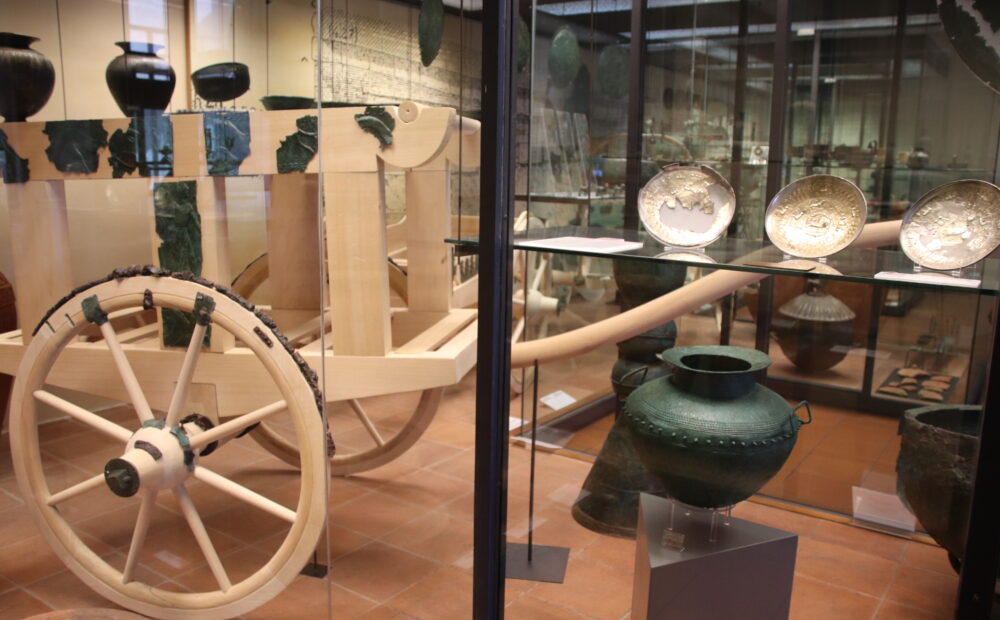
Some archaeological finds require imagination to reconstruct; this one didn’t. In Sirolo, on Italy’s Adriatic coast, researchers opened a 2,500-year-old grave and found a wooden two-wheeled chariot still sitting intact beside the skeleton of the man it was buried with.
The chariot, known as a currus, was placed at the centre of a large circular wooden enclosure alongside a helmet, an axe and several bronze vessels sealed with ceramic lids. Those vessels are believed to have held food offerings or the remains of a funeral feast intended for the afterlife — a detail that suggests the burial was as much a ritual send-off as a display of status.
The grave belongs to the Piceni, a pre-Roman civilisation that ruled the region during the sixth century BC and bordered the Etruscans to the north. The find was announced on July 1 by the Superintendency of Archaeology, Fine Arts and Landscape for the Provinces of Ancona, Pesaro and Urbino, and follows an earlier princely tomb uncovered in the same cemetery in 2020 that contained an iron-wheeled chariot and its own set of weapons.
Right beside the chariot grave sat a second, separate burial: a woman laid to rest with textiles, shoes and fibulae, the decorative pins used to fasten ancient clothing. One fibula, set with amber, was found near her head and may have once been part of a headdress. Her grave lies close to the well-documented Queen’s Tomb, discovered in 1989, which contained a Piceni woman buried with two chariots and two mules.
The cemetery itself stands out structurally too. While earlier Piceni burial sites were typically bounded by a ditch, this one was enclosed by a wooden palisade and built on a small hill — a layout researchers believe was meant to signal the site’s importance. It marks, they say, the first time an entire aristocratic nucleus of the Piceni has been identified in one place.


Leave a Reply