Penguins Are Diving Deeper Than Ever for Food That Never Left
A new study tracking more than 6,000 penguin dives beneath Antarctic sea ice finds that krill become harder to reach even when their numbers have not fallen.
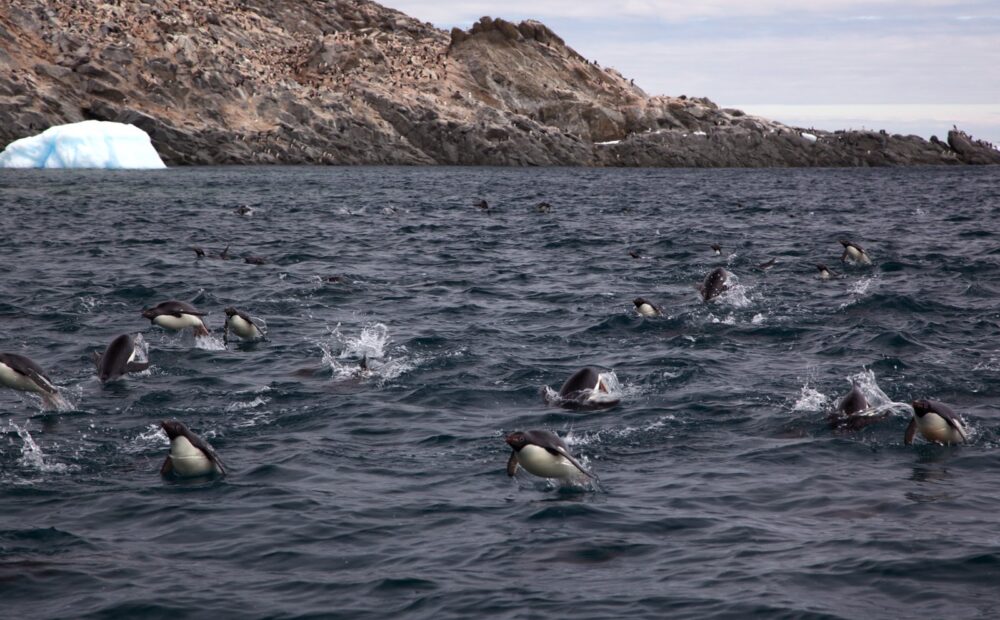
For nesting penguins in Antarctica, finding a meal is no longer just a question of how many fish or krill are swimming in the ocean nearby. According to a new study, it is increasingly a question of how hard those animals have become to catch.
Scientists who tracked more than 6,000 penguin dives beneath Antarctic sea ice found that prey can turn much harder to reach even when their overall numbers have not dropped. Rather than simply eating their food supply down until it nearly disappears, the repeated presence of hunting penguins pushes krill and fish to change behaviour, moving deeper into the water or spreading out to avoid the birds. The result is that penguins have to work far harder to find the same meal.
The study, published on 15 July in the Proceedings of the Royal Society B, was led by Hina T. Watanabe, a postdoctoral scholar at the National Institute of Polar Research in Japan. Her team studied breeding Adélie penguins in East Antarctica, where the bay around the colony was covered by thick sea ice, forcing the birds to enter and leave the ocean through only a small number of shared holes. That concentrated their hunting activity in the same few locations.
Researchers fitted the penguins with advanced bio-logging devices that recorded movements, dive depths and feeding events in detailed three-dimensional data, backed up by video. Altogether the team gathered information from 30 foraging trips, tracking 23 penguins across more than 6,000 dives beneath the ice.
Each time a penguin repeatedly entered the water through the same opening, it had to dive deeper and swim farther under the ice to find prey on each new dive. Yet once it reached the krill, it fed just as successfully as before — if the krill had genuinely been depleted, the birds would have found fewer of them and fed more slowly. Instead, the krill had simply moved away from the area where the penguins were hunting.
‘Food can become harder to obtain even when it has not necessarily been depleted,’ Watanabe said. Penguins searching for food close to the nesting site had to make far deeper and longer dives than those hunting farther away, even though the surrounding waters still held plenty of krill — evidence, the researchers say, that accessibility matters just as much as raw abundance when it comes to survival in the Southern Ocean.
Wikimedia Commons/by Jason Auch
Leave a Reply