Greenland Sharks Aren’t Blind After All, and Their Eyes Could Help Human Vision
A new UC Irvine study finds Greenland sharks, once thought blind, may see fine into old age, offering clues for treating age-related human vision loss.
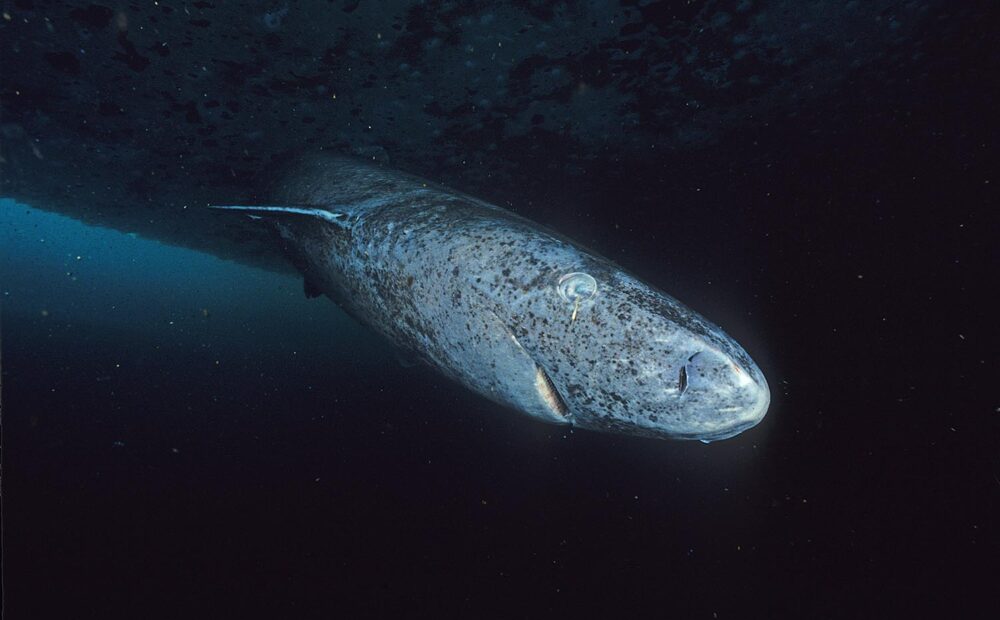
For years, scientists thought Greenland sharks were basically blind. The deep-sea creatures live in the freezing dark waters of the Arctic and often have parasites clinging to their eyes, so it seemed obvious their vision was mostly gone. A new study from researchers at the University of California, Irvine says that assumption was wrong — these sharks, which can live for hundreds of years, may actually see just fine well into old age.
The discovery began when Dorota Skowronska-Krawczyk, an associate professor at UC Irvine, watched video footage of a Greenland shark drifting through dark Arctic water and noticed something unexpected: the shark was tracking the light with its eyeball, behaviour that shouldn’t happen in an animal thought to be functionally blind.
Greenland sharks are the longest-living vertebrates known to science, with some individuals surviving up to 400 years. Their cloudy, often parasite-covered eyes, combined with their pitch-dark habitat, had long led scientists to assume they couldn’t see. Between 2020 and 2024, researchers collected Greenland sharks near Disko Island in Greenland and sent preserved eye tissue to Skowronska-Krawczyk’s lab. Emily Tom, a PhD student in the lab, examined the tissue and found no evidence of cell death in the retina — and that rhodopsin, a protein essential for seeing in dim light, was fully functional and tuned to detect blue light, the kind that travels furthest underwater.
The findings, published in Nature Communications in a paper titled ‘The visual system of the longest living vertebrate, the Greenland shark,’ were co-authored with University of Basel researchers Walter Salzburger and Lily G Fogg. The study points to a DNA repair mechanism that appears to protect the shark’s retina from the kind of damage that usually accumulates with age.
That matters for humans too, since the eye is often one of the first places age-related decline shows up, leading to conditions like macular degeneration and glaucoma. If a Greenland shark can keep its retina in near-perfect shape for centuries, understanding how it does so could open new directions for treating vision loss as people age.


Leave a Reply