This ‘Extinct’ Fish Vanished 66 Million Years Ago: Then A South African Net Proved Everyone Wrong
A coelacanth, a fish thought extinct for 66 million years, was found alive in a South African fishing trawler's catch in December 1938.
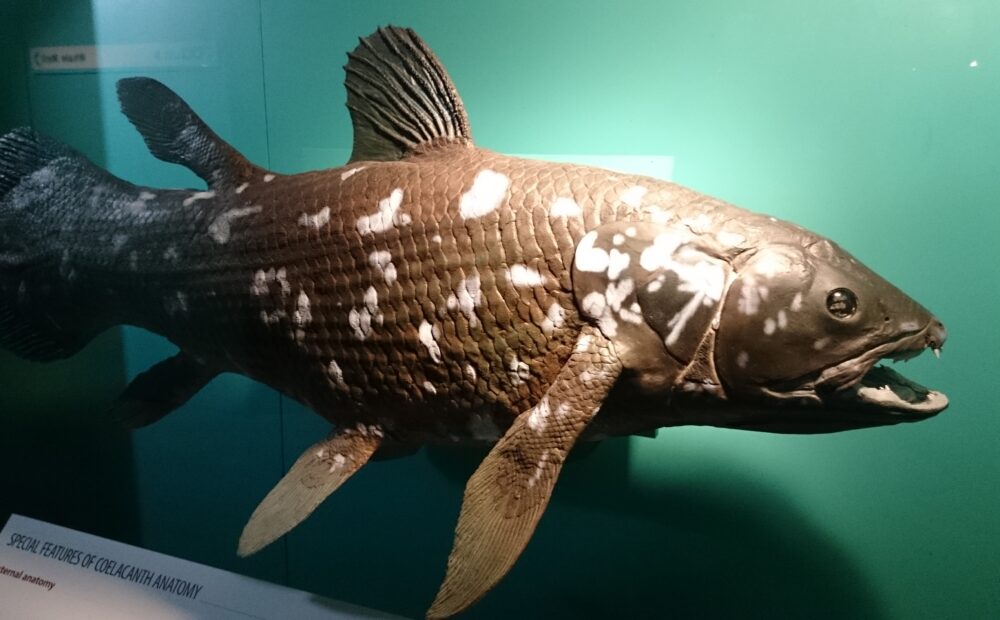
In December 1938, a fishing trawler working off the coast of South Africa hauled up a fish that, according to the fossil record, should not have existed. Museum curator Marjorie Courtenay-Latimer spotted a large blue fish, roughly 1.5 metres long, resting among the catch. Its scales formed a heavy, armour-like covering, and its fins looked nothing like those of ordinary fish.
Courtenay-Latimer sent a description and sketches to South African ichthyologist J.L.B. Smith. When Smith examined the preserved specimen weeks later, he concluded it belonged to a group known only from fossils, a lineage that had supposedly vanished from the record around 66 million years ago, alongside the dinosaurs.
Smith named the species Latimeria chalumnae, honouring both Courtenay-Latimer and the Chalumna River near where the fish was caught, according to the Natural History Museum. The find stunned the scientific community: an animal presumed gone for tens of millions of years had been quietly surviving in the depths of the Indian Ocean the whole time.
The reason nobody had noticed sooner lies in where coelacanths actually live. Unlike fish found in coastal shallows, coelacanths inhabit deep marine environments hundreds of metres down, sheltering in underwater caves by day and emerging at night to hunt squid, cuttlefish and smaller fish. In the Comoros Islands, local fishermen already knew the fish by the name ‘gombessa’ — to them it was unusual, but not unknown; the surprise belonged mainly to Western science.
The coelacanth belongs to a group called lobe-finned fishes, with fins attached to muscular lobes rather than the thin rays found on most modern fish, a feature that initially had some researchers wondering if it was a missing link between sea creatures and the first land vertebrates. Later genetic research showed lungfish are actually the closer relatives to land animals, though the coelacanth still carries a flexible notochord instead of a bony spine and a rare skull joint that lets its mouth open unusually wide.
A second coelacanth specimen turned up in the Comoros Islands in 1952, confirming the 1938 find was no isolated accident. Then, in 1997, another coelacanth appeared at a market in Indonesia. Genetic analysis showed it belonged to an entirely different species, Latimeria menadoensis, proving the surviving lineage was more diverse than anyone had realised.
Wikimedia Commons/by Nkansah Rexford
Leave a Reply